low-ceiling playroom
You cannot raise it. You can stop reminding everyone where it is. Here is how that plays out in a playroom: the layout that survives it, the furniture worth keeping, the lighting plan, and a way to preview it all on a photo of your own room.
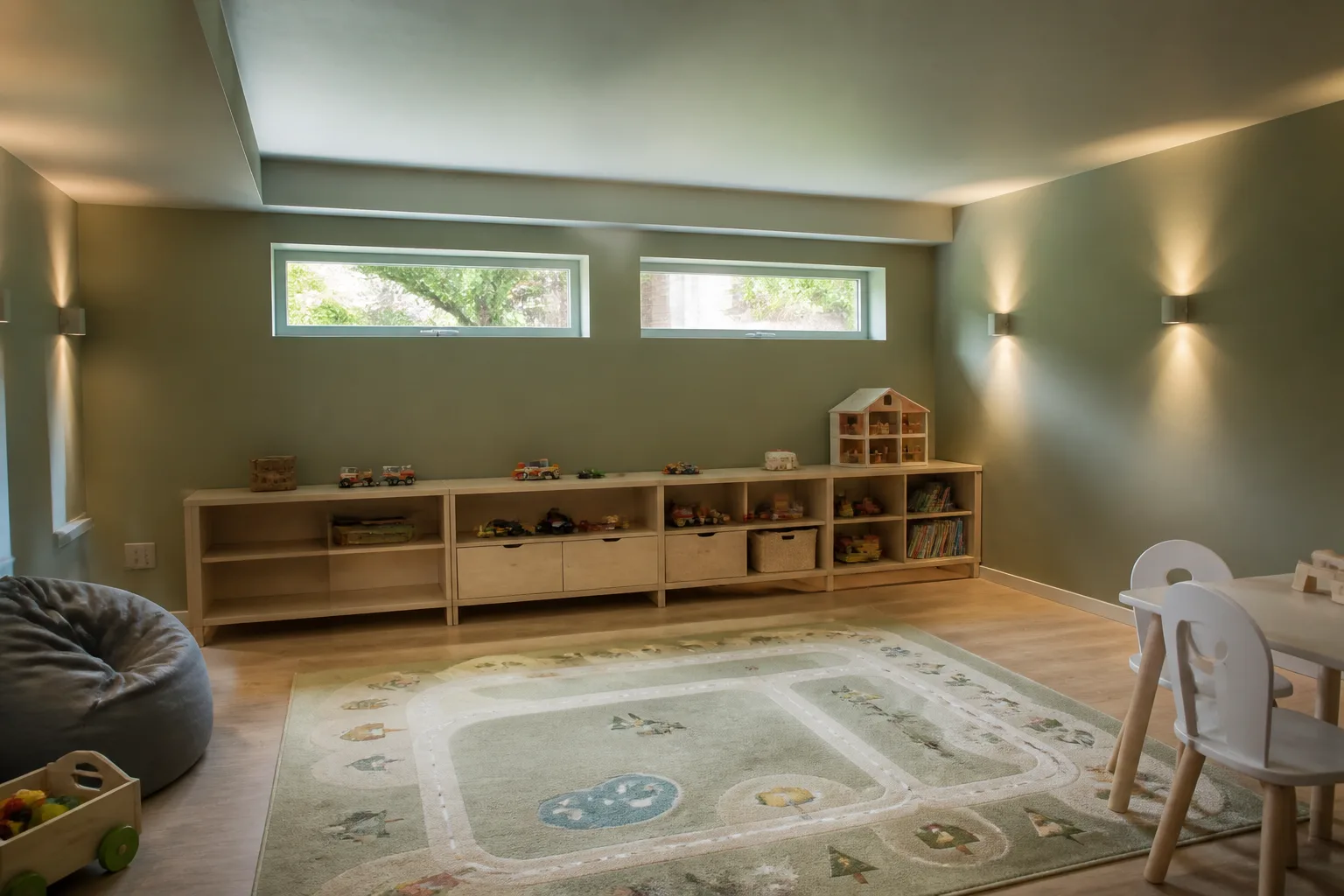
What a low-ceiling playroom is really dealing with
A ceiling under about 2.4m is only oppressive when the room keeps measuring it: pendant lights that hang into headspace, tall furniture that nearly touches, a ceiling painted a different colour so the eye finds the join. The working strategy is horizontal — low furniture, long lines, light pulled down the walls — so the space between the furniture and the ceiling reads as air rather than as a shortfall. None of that changes what the room is for: a playroom is hired to hold play AND the aftermath of play, and the second job is the one that decides the design. Open floor in the middle, activity zones at the edges, and a reset system a child can actually run: open bins below 1m with picture labels, a place for every category, and closing storage above for the rotation stock. Rooms that skip the reset system become floor-level archaeology within a month.
The layout that gets both jobs done
Hold the playroom's own numbers first — the central floor stays open: 2×2m minimum of continuous rug, no furniture islands. Then let the constraint pick the arrangement: low-slung seating and beds, which double the apparent wall height above them; ceiling and walls in the same colour, erasing the line where the room ends; flush or semi-flush ceiling fittings; pendants only over tables, where heads never go.
Furniture that earns its floor here
The pieces a playroom cannot do without are a big soft rug rated for sitting, a wall of cubby storage with labelled bins, a child-height table and chairs. Under the low-ceiling condition, each of them is auditioned against the same test: low-slung seating and beds, which double the apparent wall height above them.
What to rule out on day one
The low-ceiling version of this room punishes pendants and chandeliers in circulation space; tall wardrobes stopping 20cm short of the ceiling — the gap measures the room. And the playroom's own classic error still applies: one giant toy chest, where every toy migrates to the bottom and dies.
Lighting it
Uplight everything you can — wall washers, lamps that throw light upward, LED tape on top of cabinetry. A low ceiling that is bright reads as open; the same ceiling with a shadowed centre reads like a hand pressing down. Bright, even and shadow-free for play — the one room where a strong ceiling layer leads — plus a softer lamp near the reading corner. Skip floor lamps entirely; they are toddler-height masts with cables.
The move to make this weekend
Repaint the ceiling the exact colour of the walls, in the flattest finish available. The join disappears, the eye stops finding the lid, and every other trick starts from a better baseline. In a playroom that lands next to the fixed rule of the room: anchor every bookcase and tall unit to the wall — this is the room where climbing is guaranteed.
Dimensions to hold onto
However the finishes go, the geometry stays: Daily-toy storage lives at 30cm–1m height; below 30cm gets ignored, above 1m gets climbed for. A craft table needs 55–60cm of seated clearance behind each chair, in washable-floor territory.
Questions
- Is a low-ceiling playroom worth designing around?
- Yes — you cannot raise it. You can stop reminding everyone where it is. The pages here treat the low-ceiling condition as the starting brief, not a defect to apologise for.
- Which single change helps a low-ceiling playroom most?
- Repaint the ceiling the exact colour of the walls, in the flattest finish available. The join disappears, the eye stops finding the lid, and every other trick starts from a better baseline.
- How do I light a low-ceiling playroom?
- Uplight everything you can — wall washers, lamps that throw light upward, LED tape on top of cabinetry. A low ceiling that is bright reads as open; the same ceiling with a shadowed centre reads like a hand pressing down.
- What gets bought and regretted most in this room?
- One giant toy chest, where every toy migrates to the bottom and dies. Under the low-ceiling condition, add: pendants and chandeliers in circulation space.
- Can I try these ideas on a photo of my own playroom?
- That is what the Studio is for: upload a photo of the actual room and redesign it with the low-ceiling playbook applied. A new account starts with 4 free credits and a Standard render costs 4, so the first look is free.