shared nursery
Two people’s stuff, tastes and hours in one room. The design is the treaty. Here is how that plays out in a nursery: the layout that survives it, the furniture worth keeping, the lighting plan, and a way to preview it all on a photo of your own room.
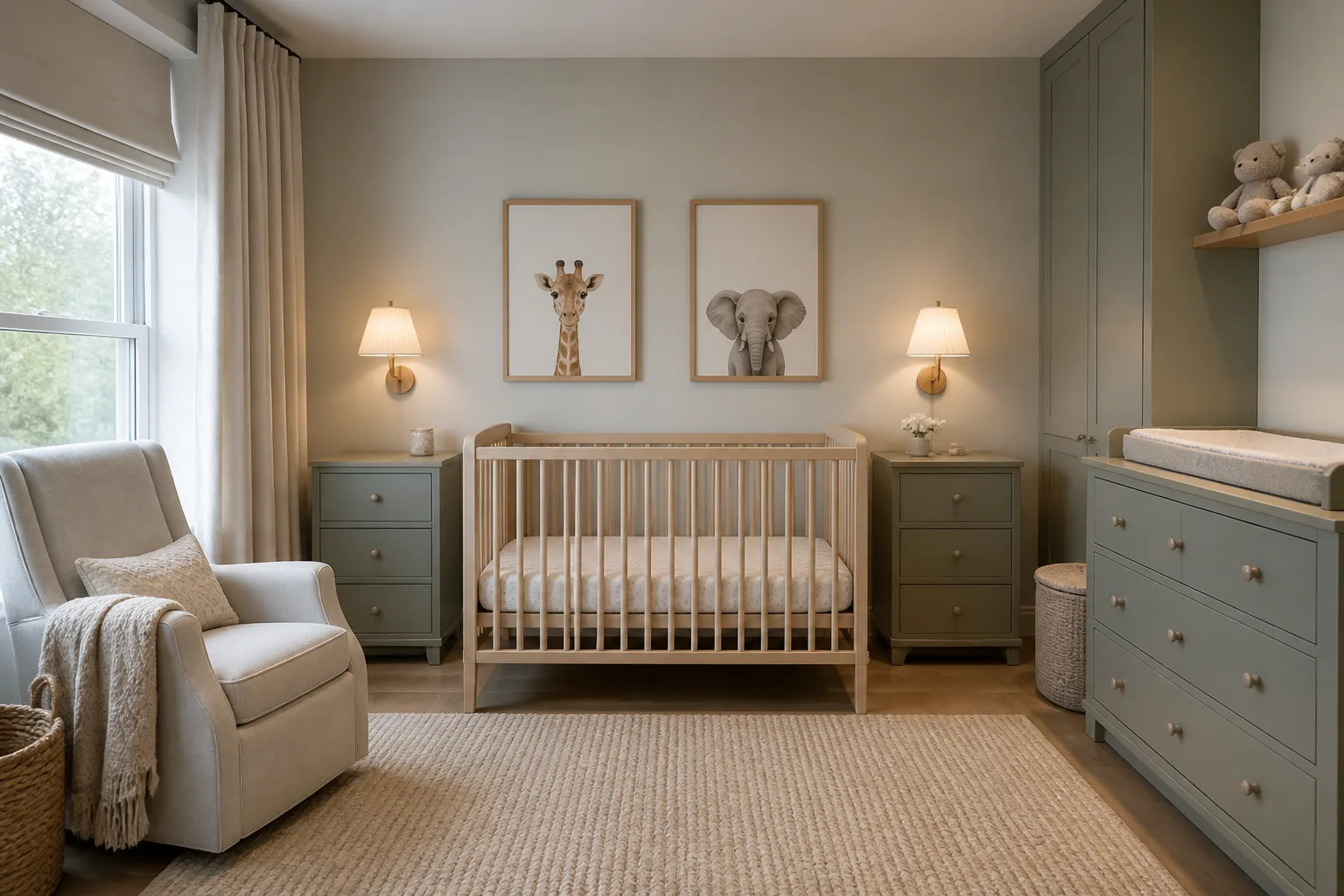
What a shared nursery is really dealing with
A shared room — couple, siblings, flatmates — fails when it is designed as one person’s room that another person sleeps in. It needs symmetry where the sharing is equal (bedside tables, lamps, storage volume) and honest asymmetry where it is not (the early riser gets the wardrobe by the door; the desk belongs to whoever works). The visible surfaces need a jointly agreed palette precisely because the invisible ones — drawers, cupboards — are where each person’s chaos gets to live unjudged. None of that changes what the room is for: the nursery’s real user is a sleep-deprived parent holding seven kilos in the dark, and every layout decision should be tested against that user: cot reachable without obstacles, changing supplies at one-hand height, a feeding chair with everything in arm’s reach, a light that comes on at 5% not 100%. The baby, for their part, needs safe sleep clearances and darkness. The Instagram nursery optimises a third user — the camera — and the camera does not do night feeds.
The layout that gets both jobs done
Hold the nursery's own numbers first — the cot stays clear of windows, blind cords, radiators and anything climbable-adjacent; 50cm from the radiator minimum. Then let the constraint pick the arrangement: equal storage volume per person, enforced by furniture rather than promises; a bedside table and reachable light per sleeper, non-negotiable; one shared palette for visible surfaces, chosen together, however plain.
Furniture that earns its floor here
The pieces a nursery cannot do without are a cot placed by safety rules first, a genuinely comfortable feeding chair — the most-used seat in the house for a year, a changing station with one-hand storage. Under the shared condition, each of them is auditioned against the same test: equal storage volume per person, enforced by furniture rather than promises.
What to rule out on day one
The shared version of this room punishes one person’s taste applied wall to wall as a fait accompli; a single ceiling light governed by whoever is nearest the switch. And the nursery's own classic error still applies: open shelves of tiny objects above the cot — earthquake logic applies even where earthquakes do not.
Lighting it
Independent control matters more than fixture beauty: two dim personal sources outperform one perfect pendant, because a shared room is two schedules pretending to be one. Everything dimmable to almost nothing: a 5–10% warm night level for feeds, a soft general layer for the bedtime routine, and daylight control good enough for a 1pm nap in June. Any light visible from the cot should be indirect.
The move to make this weekend
Give each sleeper their own controllable light this week — a clip lamp counts. Most shared-room friction is really lighting friction, and it dissolves the day both people can read, wake and wind down on their own schedule. In a nursery that lands next to the fixed rule of the room: a clear 60cm path door-to-cot, walkable in near-darkness, no rug edges en route.
Dimensions to hold onto
However the finishes go, the geometry stays: Changing surface at 85–95cm with supplies reachable by one hand while the other never leaves the baby. The feeding chair needs 75cm to rock or recline, a side table at elbow height, and a footstool.
Questions
- Is a shared nursery worth designing around?
- Yes — two people’s stuff, tastes and hours in one room. The design is the treaty. The pages here treat the shared condition as the starting brief, not a defect to apologise for.
- Which single change helps a shared nursery most?
- Give each sleeper their own controllable light this week — a clip lamp counts. Most shared-room friction is really lighting friction, and it dissolves the day both people can read, wake and wind down on their own schedule.
- How do I light a shared nursery?
- Independent control matters more than fixture beauty: two dim personal sources outperform one perfect pendant, because a shared room is two schedules pretending to be one.
- What gets bought and regretted most in this room?
- Open shelves of tiny objects above the cot — earthquake logic applies even where earthquakes do not. Under the shared condition, add: one person’s taste applied wall to wall as a fait accompli.
- Can I try these ideas on a photo of my own nursery?
- That is what the Studio is for: upload a photo of the actual room and redesign it with the shared playbook applied. A new account starts with 4 free credits and a Standard render costs 4, so the first look is free.