Dark rooms
Not enough daylight to pretend otherwise. Two honest strategies; pick one.
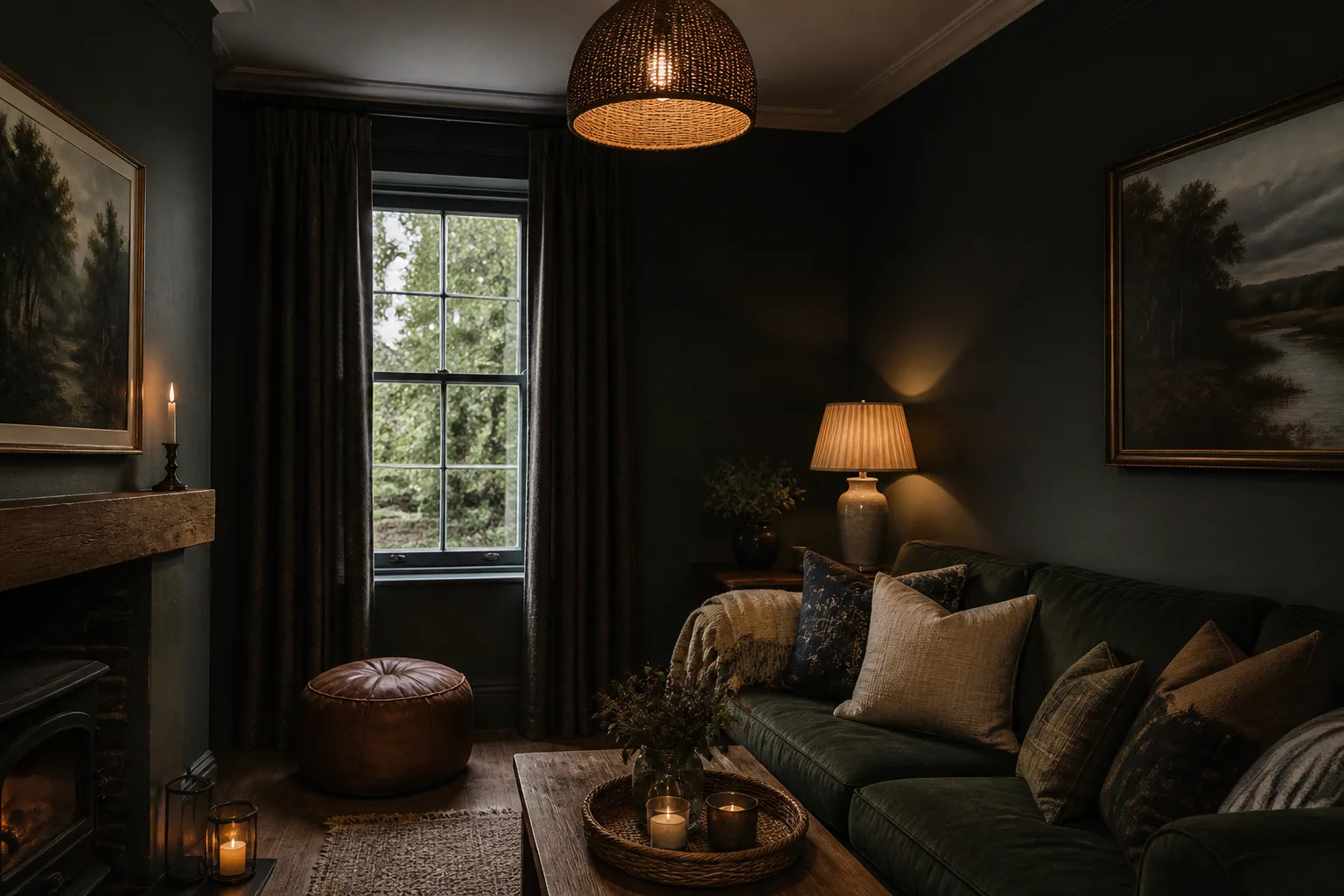
What the condition actually does
A genuinely dark room — small window, wrong orientation, blocked light — offers a fork. Strategy one maximises what little arrives: pale warm surfaces, mirror placed to bounce the window deeper, nothing blocking the glass. Strategy two surrenders gloriously: deep saturated walls, layered lamplight, the room recast as an evening place that happens to be usable at noon. Both work. The failure is the middle path — a beige room with one ceiling light, permanently dim and pretending not to be.
The first move
Clear the window completely — curtains re-hung wider than the frame, blind raised fully, sill emptied. Rooms routinely hide a fifth of their own daylight behind fabric and clutter, and this costs nothing to find out.
Light under this condition
Think in pools, not levels: a dark room lit by four warm pools reads as intentional and cosy, while the same room under one bright ceiling light reads as an interrogation of its own flaws.
What fights it
- Half-measures: mid-tone walls, one pendant, and hope
- Furniture placed against the window wall, mugging the room of its one source
- Cool-white bulbs compensating for missing daylight with office light
Dark rooms, room by room
28 rooms- Dark living room
- Dark family room
- Dark den
- Dark media room
- Dark playroom
- Dark game room
- Dark bedroom
- Dark main bedroom
- Dark guest bedroom
- Dark kids’ bedroom
- Dark teen bedroom
- Dark nursery
- Dark dorm room
- Dark home office
- Dark study
- Dark craft room
- Dark home library
- Dark home gym
- Dark kitchen
- Dark kitchen-diner
- Dark dining room
- Dark breakfast nook
- Dark bathroom
- Dark ensuite
- Dark laundry room
- Dark walk-in closet
- Dark entryway
- Dark hallway
See your own room designed around it
Upload a photo and the Studio applies the dark playbook to the room you actually have.
Open the Studio