dark living room
Not enough daylight to pretend otherwise. Two honest strategies; pick one. Here is how that plays out in a living room: the layout that survives it, the furniture worth keeping, the lighting plan, and a way to preview it all on a photo of your own room.
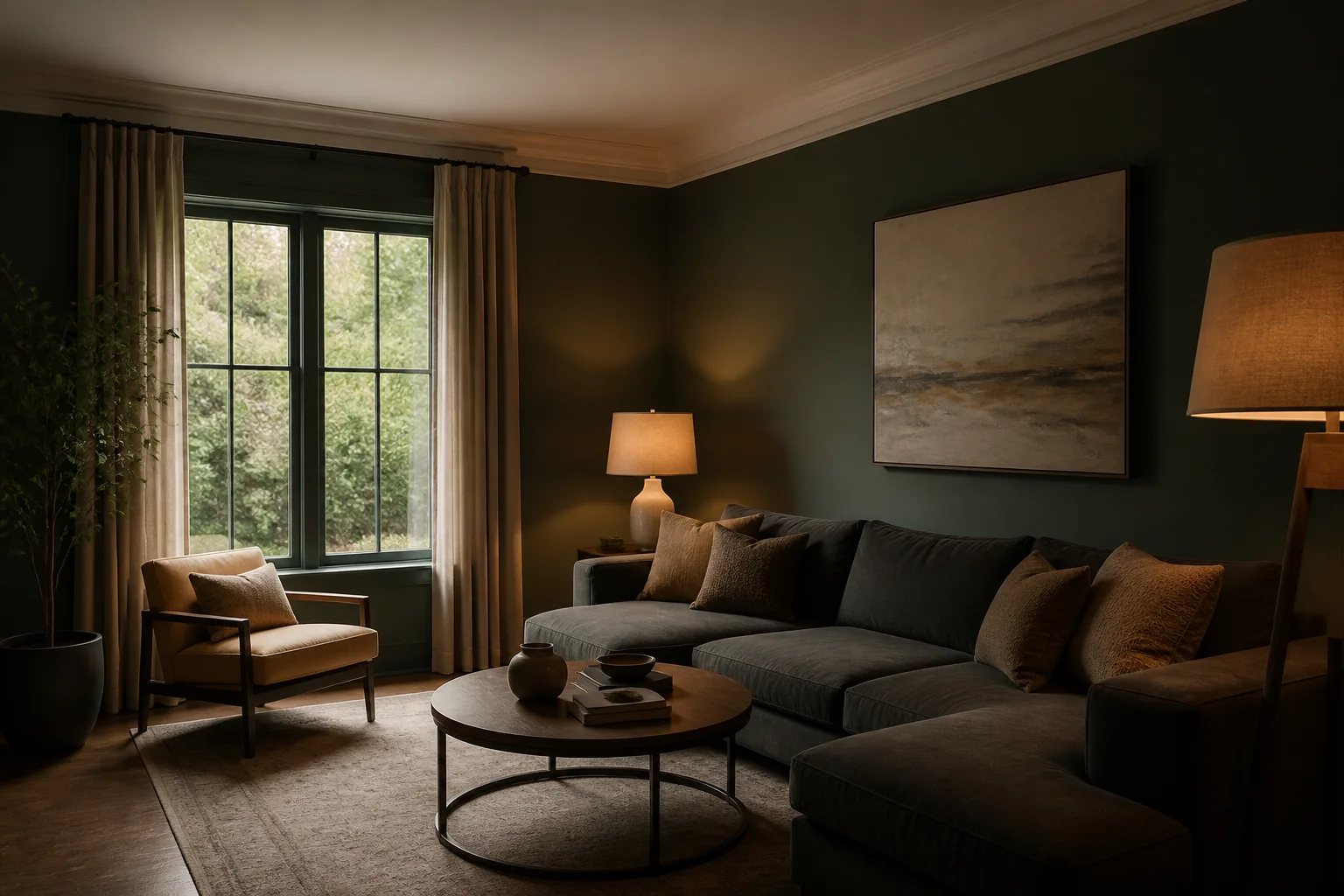
What a dark living room is really dealing with
A genuinely dark room — small window, wrong orientation, blocked light — offers a fork. Strategy one maximises what little arrives: pale warm surfaces, mirror placed to bounce the window deeper, nothing blocking the glass. Strategy two surrenders gloriously: deep saturated walls, layered lamplight, the room recast as an evening place that happens to be usable at noon. Both work. The failure is the middle path — a beige room with one ceiling light, permanently dim and pretending not to be. None of that changes what the room is for: a living room is hired for conversation first and screens second, and the layout says which one it believes in. Seats that face each other within 2.5m make talk easy; seats lined up at a television make an audience. The best rooms solve both with one arrangement — a sofa and two chairs at an L, the screen off-axis — and keep a clear route through that never crosses the middle of a conversation.
The layout that gets both jobs done
Hold the living room's own numbers first — keep 2.2–2.8m between facing seats — closer feels confrontational, further needs a raised voice. Then let the constraint pick the arrangement: a full-commitment choice: bounce-everything pale, or embrace-the-dark saturated; the window treated as sacred: no curtains stacked over glass, sills kept clear; a mirror on the wall perpendicular to the window, pushing light along the room.
Furniture that earns its floor here
The pieces a living room cannot do without are a sofa sized to the wall it lives on, two chairs that can turn to face it, one coffee table large enough to share. Under the dark condition, each of them is auditioned against the same test: a full-commitment choice: bounce-everything pale, or embrace-the-dark saturated.
What to rule out on day one
The dark version of this room punishes half-measures: mid-tone walls, one pendant, and hope; furniture placed against the window wall, mugging the room of its one source. And the living room's own classic error still applies: all seating against the walls with a void in the middle — a waiting room with cushions.
Lighting it
Think in pools, not levels: a dark room lit by four warm pools reads as intentional and cosy, while the same room under one bright ceiling light reads as an interrogation of its own flaws. Five sources, three heights: two table or floor lamps at seat level, a reading light where reading happens, something low behind the seating for depth, and the ceiling fixture on a dimmer as backdrop rather than lead. The room should work with the ceiling light off entirely.
The move to make this weekend
Clear the window completely — curtains re-hung wider than the frame, blind raised fully, sill emptied. Rooms routinely hide a fifth of their own daylight behind fabric and clutter, and this costs nothing to find out. In a living room that lands next to the fixed rule of the room: leave 75cm behind any chair that gets pulled out or reclined.
Dimensions to hold onto
However the finishes go, the geometry stays: A coffee table sits 40–45cm from the sofa edge: reachable seated, passable standing. Main walking routes need 90cm; between-furniture squeezes can drop to 60cm.
Questions
- Is a dark living room worth designing around?
- Yes — not enough daylight to pretend otherwise. Two honest strategies; pick one. The pages here treat the dark condition as the starting brief, not a defect to apologise for.
- Which single change helps a dark living room most?
- Clear the window completely — curtains re-hung wider than the frame, blind raised fully, sill emptied. Rooms routinely hide a fifth of their own daylight behind fabric and clutter, and this costs nothing to find out.
- How do I light a dark living room?
- Think in pools, not levels: a dark room lit by four warm pools reads as intentional and cosy, while the same room under one bright ceiling light reads as an interrogation of its own flaws.
- What gets bought and regretted most in this room?
- All seating against the walls with a void in the middle — a waiting room with cushions. Under the dark condition, add: half-measures: mid-tone walls, one pendant, and hope.
- Can I try these ideas on a photo of my own living room?
- That is what the Studio is for: upload a photo of the actual room and redesign it with the dark playbook applied. A new account starts with 4 free credits and a Standard render costs 4, so the first look is free.