multifunctional game room
Office by day, guest room by weekend, gym at 7am. Rooms can moonlight; they cannot double-book. Here is how that plays out in a game room: the layout that survives it, the furniture worth keeping, the lighting plan, and a way to preview it all on a photo of your own room.
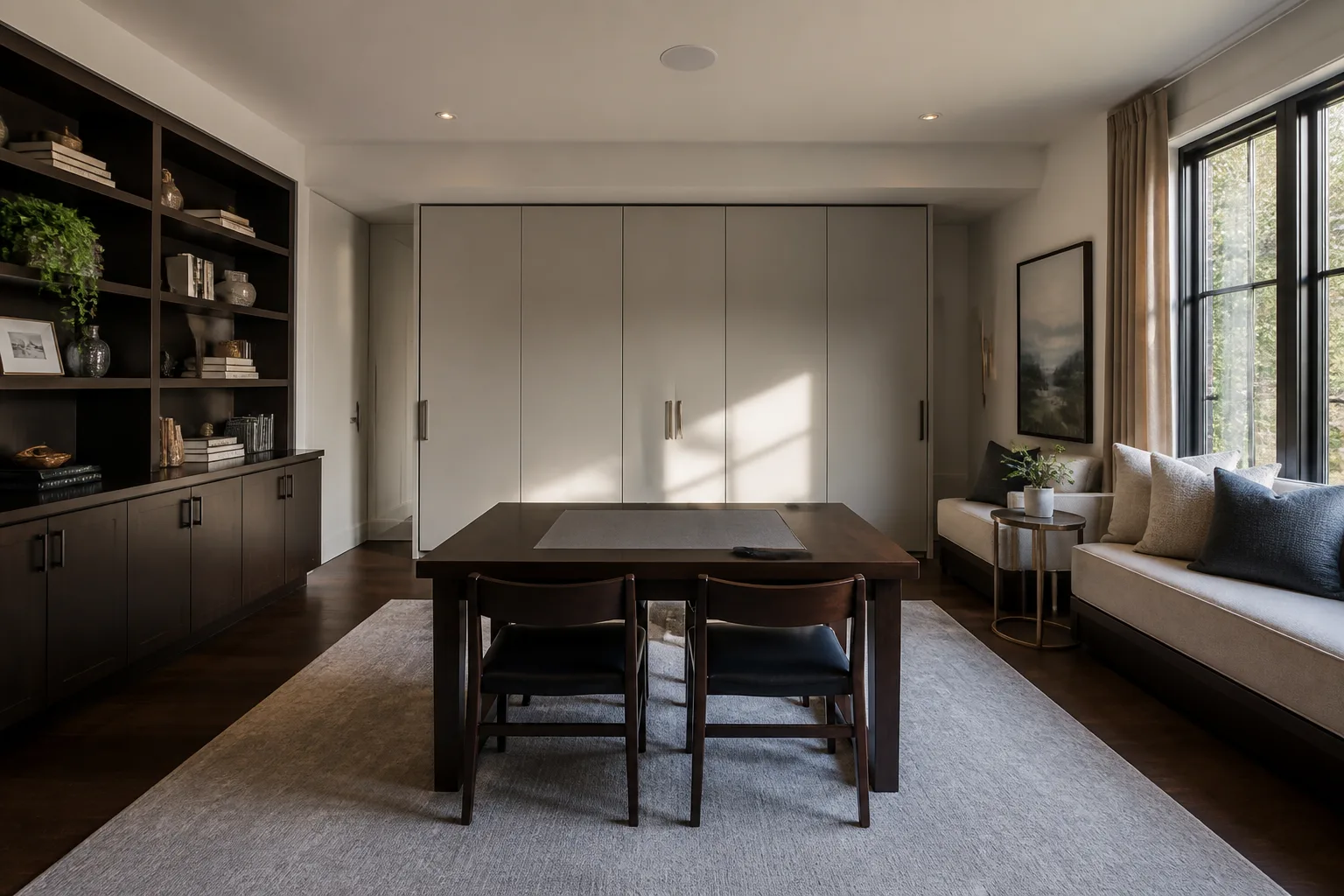
What a multifunctional game room is really dealing with
A room can hold several jobs if they take turns, and no jobs that fight at the same hour — the office-guest-room works because Tuesday 2pm and Saturday night never meet, while the office-nursery fails at the first overlapping nap. The mechanics are switchable furniture (sofa bed, fold desk, murphy bed), per-job lighting scenes, and a strict putting-away discipline: each job’s kit vanishes completely when the other job is on shift, or the room ends up doing both badly at once. None of that changes what the room is for: a game room is hired around its tables, and every table has a service zone the room must honour: a pool cue needs 1.5m of swing on all sides, a card table needs pushed-back chairs, a console corner needs its cinema-lite sightline. Plan the zones first at full clearance, and only then see what seating and bar space the leftovers allow. Rooms planned furniture-first end up with a pool table nobody can shoot the left side of.
The layout that gets both jobs done
Hold the game room's own numbers first — pool: table footprint PLUS 1.5m all round for the cue — a 7ft table truly needs 5×4m of room. Then let the constraint pick the arrangement: jobs paired by schedule: day + night, weekday + weekend, never simultaneous; one hero convertible — murphy bed, proper sofa bed, fold-away desk — bought well; a lighting scene per job: work-bright at the desk, warm and low for the guest evening.
Furniture that earns its floor here
The pieces a game room cannot do without are the hero table, placed first, perimeter seating that waits its turn, a shelf or cabinet of games within reach of the table. Under the multifunctional condition, each of them is auditioned against the same test: jobs paired by schedule: day + night, weekday + weekend, never simultaneous.
What to rule out on day one
The multifunctional version of this room punishes both jobs visible at once — a bed facing a desk serves neither sleep nor work; cheap versions of both setups instead of a good version of the switch. And the game room's own classic error still applies: a pool table bought for the room it almost fits — every wall shot played at half-cue forever.
Lighting it
Scenes, not fixtures: the same room needs a 4000K desk hour and a 2700K guest evening, so put the difference on switches and dimmers rather than buying two rooms’ worth of lamps. Task light over each game surface — the classic low pendant over the felt is correct, at about 80cm above the table — with the rest of the room a step dimmer, so the game is the stage and the perimeter is the audience.
The move to make this weekend
Decide which job is the landlord and which is the tenant, out loud. Every following choice — what the room looks like at rest, what gets the window, what folds away — falls out of that one ranking. In a game room that lands next to the fixed rule of the room: console zone follows media-room rules: 1.5–2× diagonal, seat backs to the traffic.
Dimensions to hold onto
However the finishes go, the geometry stays: Card and board tables: 75cm behind each chair to sit down, 100cm to walk behind a seated player. Darts: 2.37m throw line, plus a metre of no-walk zone behind the thrower.
Questions
- Is a multifunctional game room worth designing around?
- Yes — office by day, guest room by weekend, gym at 7am. Rooms can moonlight; they cannot double-book. The pages here treat the multifunctional condition as the starting brief, not a defect to apologise for.
- Which single change helps a multifunctional game room most?
- Decide which job is the landlord and which is the tenant, out loud. Every following choice — what the room looks like at rest, what gets the window, what folds away — falls out of that one ranking.
- How do I light a multifunctional game room?
- Scenes, not fixtures: the same room needs a 4000K desk hour and a 2700K guest evening, so put the difference on switches and dimmers rather than buying two rooms’ worth of lamps.
- What gets bought and regretted most in this room?
- A pool table bought for the room it almost fits — every wall shot played at half-cue forever. Under the multifunctional condition, add: both jobs visible at once — a bed facing a desk serves neither sleep nor work.
- Can I try these ideas on a photo of my own game room?
- That is what the Studio is for: upload a photo of the actual room and redesign it with the multifunctional playbook applied. A new account starts with 4 free credits and a Standard render costs 4, so the first look is free.