small home office
The room is fine. The furniture catalogue was written for a different one. Here is how that plays out in a home office: the layout that survives it, the furniture worth keeping, the lighting plan, and a way to preview it all on a photo of your own room.
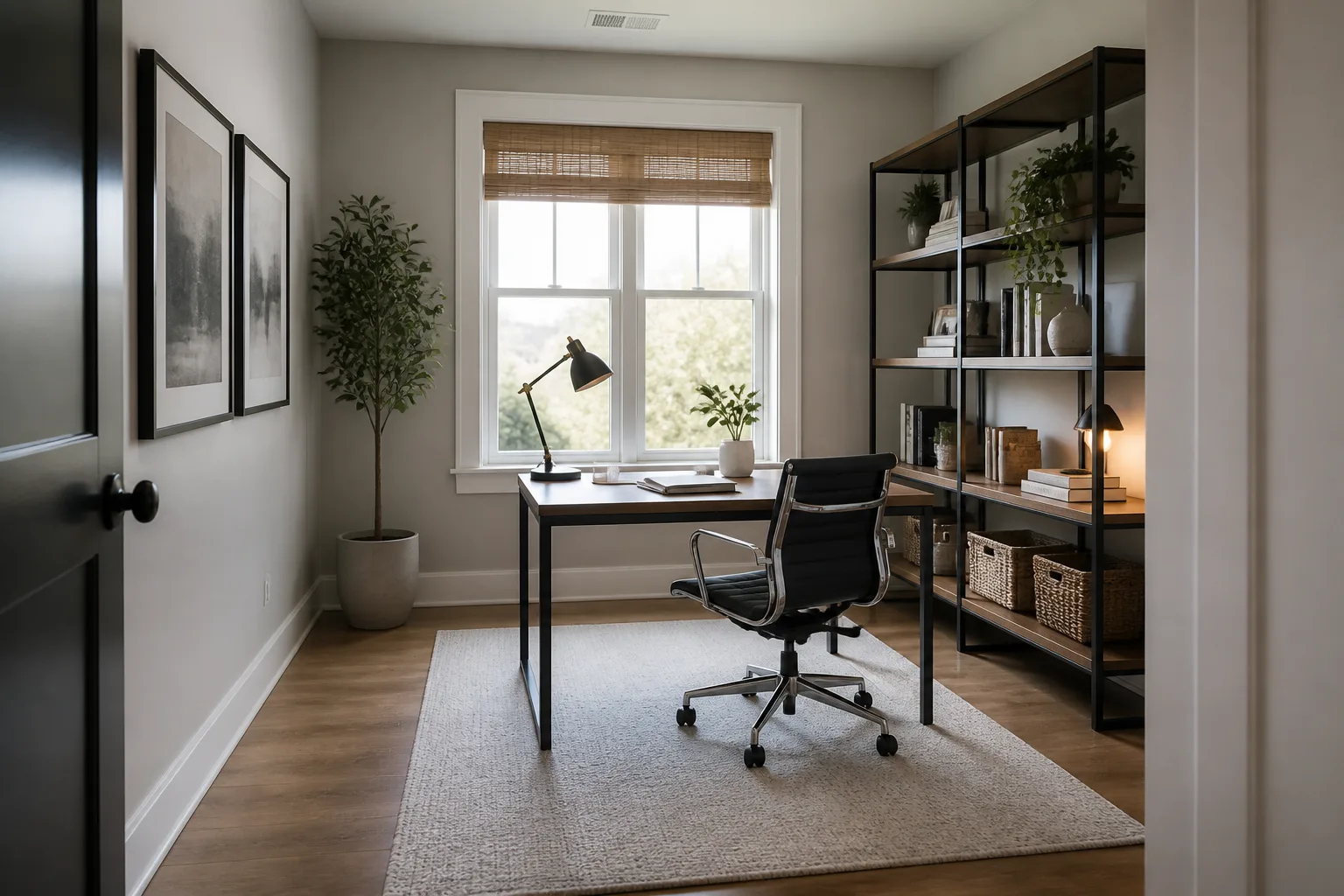
What a small home office is really dealing with
A small room fails at the edges: every piece that almost fits steals the walking line, and three almost-fits make the room unusable. The floor you can still see matters more than the floor you cover — a small room with 60% of its floor visible reads calm, and the same room at 30% reads full, whatever the style. Scale is the whole game; colour and pattern are tiebreakers. None of that changes what the room is for: a home office is hired for focus and video presence, in that order. Focus is a layout problem: desk positioned so the door is visible but the traffic is not, window light arriving from the side, and the room’s other temptations — bed, sofa, laundry — out of the working sightline. Presence is the reverse angle: whatever sits behind the chair is your professional wallpaper, so it gets designed on purpose. The third job is the hardest: the room must switch off at day’s end, or the house has no end of day.
The layout that gets both jobs done
Hold the home office's own numbers first — desk: 120×60cm minimum for screen work; 140×70cm once papers exist. Then let the constraint pick the arrangement: one properly sized anchor piece instead of three apologetic ones; furniture with visible legs, so the floor runs underneath and the room keeps its edges; wall-mounted lighting and shelving — the floor is too valuable to spend on stands.
Furniture that earns its floor here
The pieces a home office cannot do without are a desk at real dimensions, not a console pretending, the best chair the budget carries — it is the room’s mattress, a shelf or cabinet wall that is the call backdrop. Under the small condition, each of them is auditioned against the same test: one properly sized anchor piece instead of three apologetic ones.
What to rule out on day one
The small version of this room punishes pairs of things — two armchairs, two side tables — in a room with space for one; sofas with rolled arms and skirts that sit visually on the floor. And the home office's own classic error still applies: desk facing the wall for focus, back to the door — focus is a myth when the doorway is behind your head.
Lighting it
One ceiling light flattens a small room into a box. Two or three low-wattage sources at different heights — a wall light, a table lamp, something behind the seating — give it the depth the floor plan cannot. Task light for the desk, a 4000K-ish daytime fill that keeps winter afternoons honest, one warm lamp for the last hour, and the call test: light your face from the front at screen height (a small LED panel or a window, never the ceiling), and check yourself on camera once at 9am and once at 4pm.
The move to make this weekend
Take one piece of furniture out entirely — the piece you route around when you cross the room. The room gets bigger for free, and you learn which of the remaining pieces is next. In a home office that lands next to the fixed rule of the room: the video-call background is the 2m arc behind the chair: shelves, art or calm wall, no bed, no door swinging open.
Dimensions to hold onto
However the finishes go, the geometry stays: Chair zone: 75cm behind the desk to sit, stand and pivot without wall-scraping. Screen top at eye height; window at 90° to the screen — never behind it (glare) or behind you (silhouette).
Questions
- Is a small home office worth designing around?
- Yes — the room is fine. The furniture catalogue was written for a different one. The pages here treat the small condition as the starting brief, not a defect to apologise for.
- Which single change helps a small home office most?
- Take one piece of furniture out entirely — the piece you route around when you cross the room. The room gets bigger for free, and you learn which of the remaining pieces is next.
- How do I light a small home office?
- One ceiling light flattens a small room into a box. Two or three low-wattage sources at different heights — a wall light, a table lamp, something behind the seating — give it the depth the floor plan cannot.
- What gets bought and regretted most in this room?
- Desk facing the wall for focus, back to the door — focus is a myth when the doorway is behind your head. Under the small condition, add: pairs of things — two armchairs, two side tables — in a room with space for one.
- Can I try these ideas on a photo of my own home office?
- That is what the Studio is for: upload a photo of the actual room and redesign it with the small playbook applied. A new account starts with 4 free credits and a Standard render costs 4, so the first look is free.