basement main bedroom
Below grade, above expectations: the room where every failure is really a light or damp failure. Here is how that plays out in a main bedroom: the layout that survives it, the furniture worth keeping, the lighting plan, and a way to preview it all on a photo of your own room.
What a basement main bedroom is really dealing with
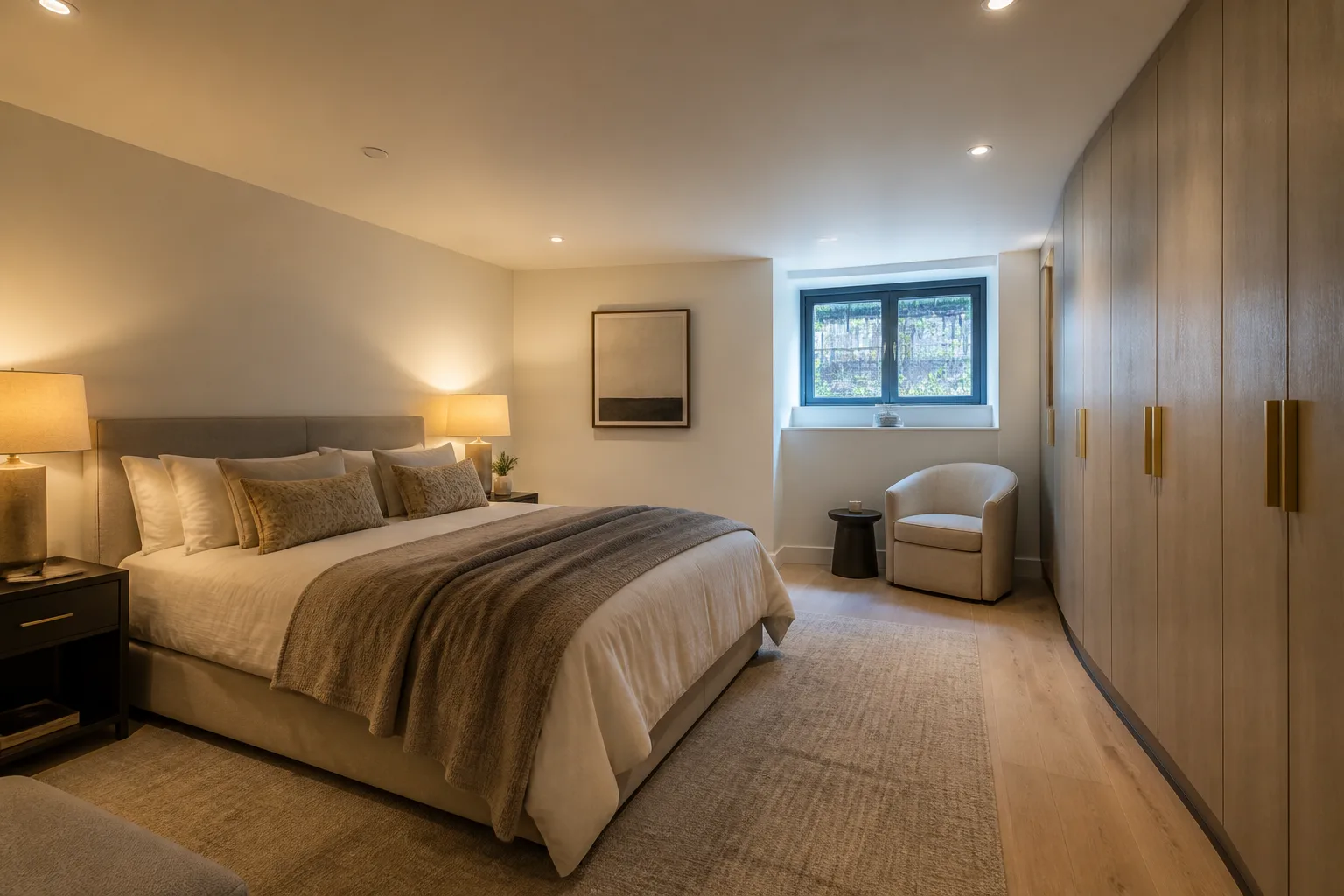
A below-grade room compounds three constraints — little or no daylight, lower ceilings, and an atmosphere that tips damp-cold without help. It is also the house’s best isolation: no neighbours below, distance from the household above, which is why cinemas, gyms, studios and dens migrate down. Design order matters: air and moisture first (a damp basement rejects every finish), light second (layered, warm, generous), looks third. Basements decorated in reverse order get redecorated. None of that changes what the room is for: the main bedroom is the house’s premium sleep space and its most contested square meterage: dressing, a reading chair, sometimes a desk or a cot all petition for floor. It works when sleep stays the landlord and each extra job pays rent — the wardrobe wall consolidated so dressing has a territory, the chair placed for reading rather than laundry, and the bed still owning the commanding position with symmetric bedsides. It fails as a studio apartment with a nicer duvet.
The layout that gets both jobs done
Hold the main bedroom's own numbers first — everything the standard bedroom requires, plus: a dressing zone needs 120cm clear in front of the wardrobe run. Then let the constraint pick the arrangement: uses that love enclosure: media room, gym, studio, den, spare sleeping; two to three times the lamp count of an equivalent upstairs room, all warm; a bright ceiling — matte pale paint, kept uncluttered — as the room’s ersatz sky.
Furniture that earns its floor here
The pieces a main bedroom cannot do without are a bed with a real headboard, centred on its wall, matched bedside tables and lights, a consolidated wardrobe wall or walk-in. Under the basement condition, each of them is auditioned against the same test: uses that love enclosure: media room, gym, studio, den, spare sleeping.
What to rule out on day one
The basement version of this room punishes pretending it is a ground-floor room: pale schemes relying on daylight that never comes; storing damp-vulnerable things (books, textiles, instruments) as "temporary" furniture. And the main bedroom's own classic error still applies: the TV on a chest angled to the bed, importing the living room into the sleep room.
Lighting it
Fake a time of day: bright neutral layer for morning uses, warm low layer for evening ones, both on dimmers. A basement with one static light level feels like 3am at every hour. The bedroom scheme plus one: a dressing light at the wardrobe that shows true colour (high CRI, neutral-warm), switched at the wardrobe. Couples get independent bedside dimming as a matter of marital engineering.
The move to make this weekend
Run a humidity check for a week before spending on finishes — a €15 hygrometer settles whether the room needs a dehumidifier before it needs a designer. Every basement that skipped this step smells like it did. In a main bedroom that lands next to the fixed rule of the room: an ensuite or walk-in door swing never crosses a bedside walkway.
Dimensions to hold onto
However the finishes go, the geometry stays: A reading chair earns its place with 70cm of legroom and its own light — otherwise it is sculpture. A bench or ottoman at the bed end wants 40cm depth and the same 90cm walkway beyond it.
Questions
- Is a basement main bedroom worth designing around?
- Yes — below grade, above expectations: the room where every failure is really a light or damp failure. The pages here treat the basement condition as the starting brief, not a defect to apologise for.
- Which single change helps a basement main bedroom most?
- Run a humidity check for a week before spending on finishes — a €15 hygrometer settles whether the room needs a dehumidifier before it needs a designer. Every basement that skipped this step smells like it did.
- How do I light a basement main bedroom?
- Fake a time of day: bright neutral layer for morning uses, warm low layer for evening ones, both on dimmers. A basement with one static light level feels like 3am at every hour.
- What gets bought and regretted most in this room?
- The TV on a chest angled to the bed, importing the living room into the sleep room. Under the basement condition, add: pretending it is a ground-floor room: pale schemes relying on daylight that never comes.
- Can I try these ideas on a photo of my own main bedroom?
- That is what the Studio is for: upload a photo of the actual room and redesign it with the basement playbook applied. A new account starts with 4 free credits and a Standard render costs 4, so the first look is free.