bright kitchen-diner
Sun all day. The enviable problem: glare, fading, and colours that will not sit still. Here is how that plays out in a kitchen-diner: the layout that survives it, the furniture worth keeping, the lighting plan, and a way to preview it all on a photo of your own room.
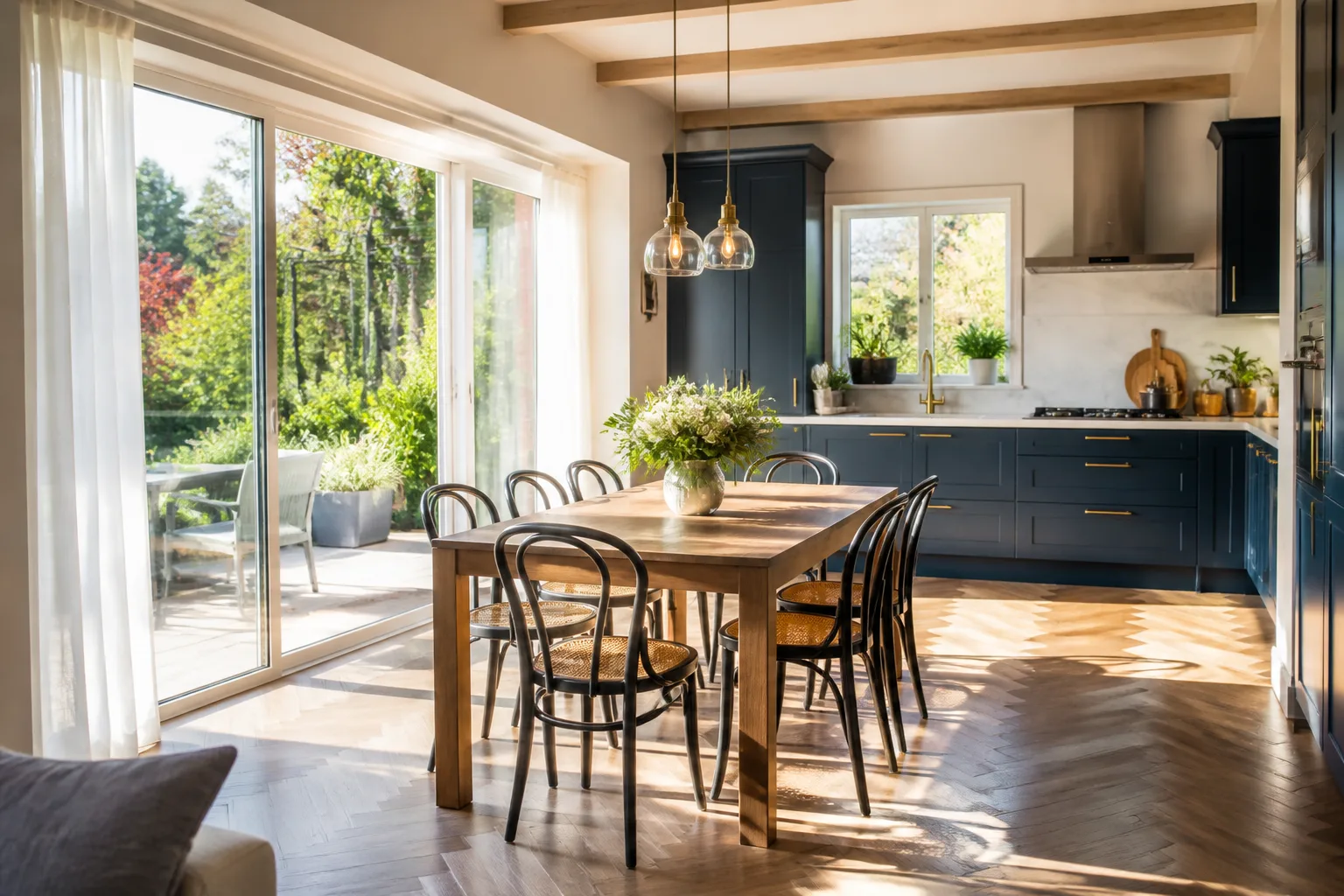
What a bright kitchen-diner is really dealing with
A bright south- or west-facing room runs hot: direct sun moves across it all day, colours shift hour by hour, screens become mirrors, and anything fugitive — cheap fabric, wood in the window line, art in direct beam — fades in a season. Strong light also flattens timid schemes; pale rooms that glow in the estate agent’s photo can read as bleached by August. Bright rooms reward saturation, texture and control, in that order. None of that changes what the room is for: a kitchen-diner is hired for togetherness — cooking and eating as one continuous social event — and its design problem is that the two halves experience each other constantly. The diners see the kitchen: it needs a calm face, closed storage toward the table, the sink ideally not the vista. The kitchen hears the diners: the cook faces the table for the social payoff the room was built for. And the boundary needs marking without walls — a level change of light, a peninsula, the rug under the table — so dinner does not feel like eating in a workroom.
The layout that gets both jobs done
Hold the kitchen-diner's own numbers first — all kitchen rules apply, plus: 120cm between the table zone and any working run, so chairs and cooks never negotiate. Then let the constraint pick the arrangement: colours with enough pigment to hold their shape in full sun — sun bleaches pastels first; layered window control: sheer for glare, blind or curtain for heat and evening; texture everywhere — weave, grain, nap — which direct light renders beautifully.
Furniture that earns its floor here
The pieces a kitchen-diner cannot do without are a table sized to the daily headcount, not the fantasy dinner party, a peninsula or island as the border checkpoint, pendants over the table claiming it as a place. Under the bright condition, each of them is auditioned against the same test: colours with enough pigment to hold their shape in full sun — sun bleaches pastels first.
What to rule out on day one
The bright version of this room punishes a tv or monitor facing the window — physics wins every afternoon; gloss surfaces in the sun line, which become glare panels. And the kitchen-diner's own classic error still applies: the table as overflow counter, permanently half-cleared, so the room has two work zones and no dining room.
Lighting it
Design the evening separately: bright rooms are often lit as an afterthought and collapse at dusk. The room that was all sun needs its lamp layer as much as a dark one does. Two rooms’ worth on separate circuits: kitchen task light that can go OFF while the table pendants stay warm — the single switch-flip that turns the workroom into a dining room at 8pm. Nothing kills the dinner like the extractor’s floodlight over the empty hob.
The move to make this weekend
Hang a sheer layer inside the main curtains. It converts the daily glare hours into soft bright ones — the room stays sunlit but stops squinting, and every colour in it becomes legible again. In a kitchen-diner that lands next to the fixed rule of the room: extraction sized to the room’s honesty: an open plan means dinner smells reaching every seat, and the fan is the only defence.
Dimensions to hold onto
However the finishes go, the geometry stays: The table needs 90cm from its edge to walls or units for seated access; 110cm on the serving side. The kitchen’s open shelving faces the cook; the closed faces face the diners.
Questions
- Is a bright kitchen-diner worth designing around?
- Yes — sun all day. The enviable problem: glare, fading, and colours that will not sit still. The pages here treat the bright condition as the starting brief, not a defect to apologise for.
- Which single change helps a bright kitchen-diner most?
- Hang a sheer layer inside the main curtains. It converts the daily glare hours into soft bright ones — the room stays sunlit but stops squinting, and every colour in it becomes legible again.
- How do I light a bright kitchen-diner?
- Design the evening separately: bright rooms are often lit as an afterthought and collapse at dusk. The room that was all sun needs its lamp layer as much as a dark one does.
- What gets bought and regretted most in this room?
- The table as overflow counter, permanently half-cleared, so the room has two work zones and no dining room. Under the bright condition, add: a TV or monitor facing the window — physics wins every afternoon.
- Can I try these ideas on a photo of my own kitchen-diner?
- That is what the Studio is for: upload a photo of the actual room and redesign it with the bright playbook applied. A new account starts with 4 free credits and a Standard render costs 4, so the first look is free.