basement craft room
Below grade, above expectations: the room where every failure is really a light or damp failure. Here is how that plays out in a craft room: the layout that survives it, the furniture worth keeping, the lighting plan, and a way to preview it all on a photo of your own room.
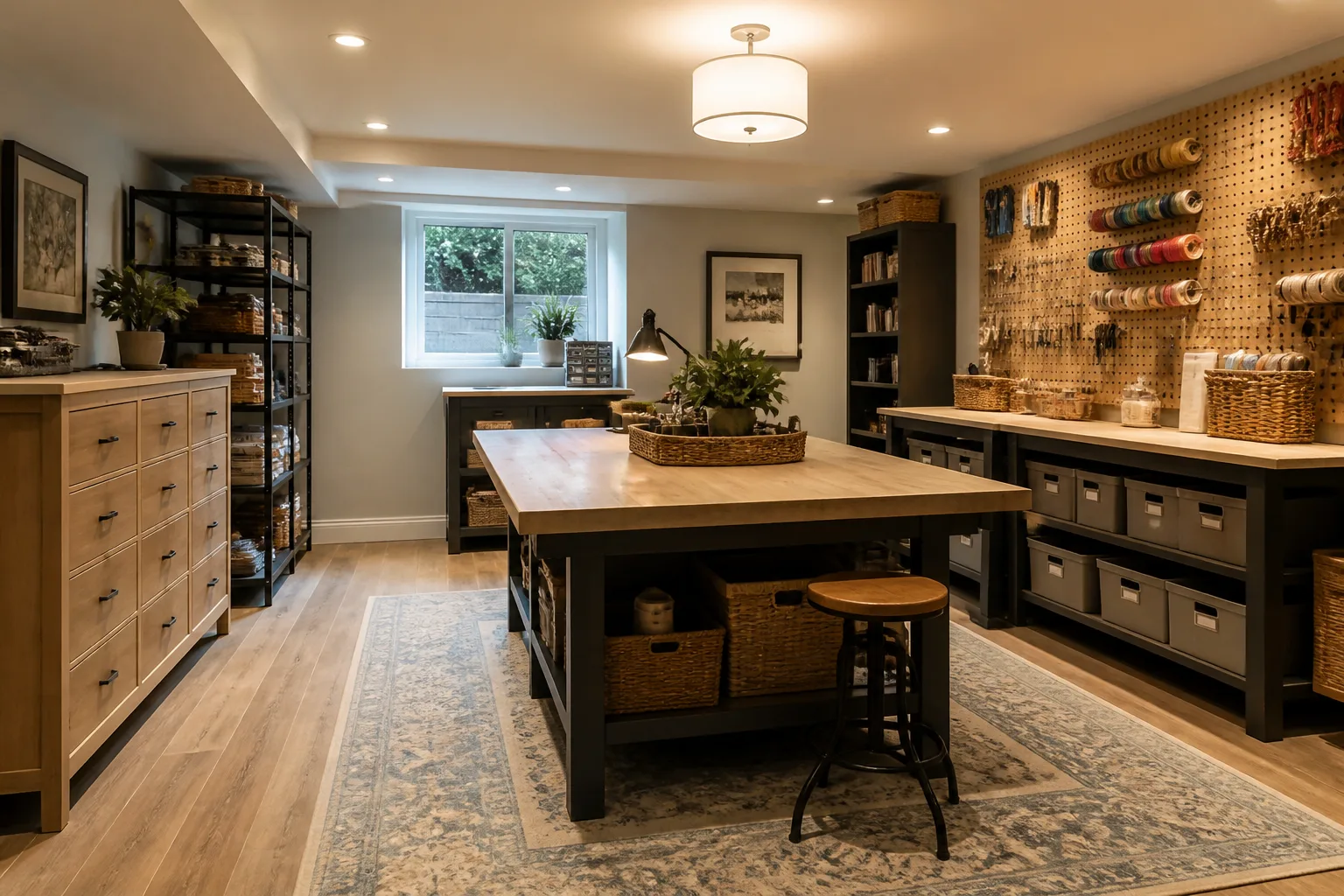
What a basement craft room is really dealing with
A below-grade room compounds three constraints — little or no daylight, lower ceilings, and an atmosphere that tips damp-cold without help. It is also the house’s best isolation: no neighbours below, distance from the household above, which is why cinemas, gyms, studios and dens migrate down. Design order matters: air and moisture first (a damp basement rejects every finish), light second (layered, warm, generous), looks third. Basements decorated in reverse order get redecorated. None of that changes what the room is for: a craft room is hired for projects that stay out: the half-finished quilt, the drying print, the sorted beads. That makes it a workshop planning problem — a work surface at the right height for the craft (sewing sits, cutting stands), storage that sorts by project rather than by object, and cleanability designed in from the floor up. The luxury it offers over the kitchen table is persistence: close the door mid-project and nothing has to be put away.
The layout that gets both jobs done
Hold the craft room's own numbers first — a seated craft surface lands at 72–76cm; a standing cutting table at 90–95cm. Then let the constraint pick the arrangement: uses that love enclosure: media room, gym, studio, den, spare sleeping; two to three times the lamp count of an equivalent upstairs room, all warm; a bright ceiling — matte pale paint, kept uncluttered — as the room’s ersatz sky.
Furniture that earns its floor here
The pieces a craft room cannot do without are the main work table, biggest the room takes, a pegboard or tool wall over it, clear-front storage — labels lie, transparency doesn’t. Under the basement condition, each of them is auditioned against the same test: uses that love enclosure: media room, gym, studio, den, spare sleeping.
What to rule out on day one
The basement version of this room punishes pretending it is a ground-floor room: pale schemes relying on daylight that never comes; storing damp-vulnerable things (books, textiles, instruments) as "temporary" furniture. And the craft room's own classic error still applies: decorative storage — ribbon-tied boxes of chaos — that turns every project into an excavation.
Lighting it
Fake a time of day: bright neutral layer for morning uses, warm low layer for evening ones, both on dimmers. A basement with one static light level feels like 3am at every hour. The house’s brightest room: a strong neutral overhead layer (this is the one room where 4000K everywhere is right), plus a task lamp at the needle or blade. Colour-accurate light matters — thread matched under warm light is a different colour by daylight.
The move to make this weekend
Run a humidity check for a week before spending on finishes — a €15 hygrometer settles whether the room needs a dehumidifier before it needs a designer. Every basement that skipped this step smells like it did. In a craft room that lands next to the fixed rule of the room: a finishing zone where things dry or block undisturbed: 60cm of shelf or line, out of the walking path.
Dimensions to hold onto
However the finishes go, the geometry stays: Walk-around access to the main table on at least two sides: 60cm each. Frequently used tools within the seated reach arc — 60cm — and pegboard beats drawers for anything used weekly.
Questions
- Is a basement craft room worth designing around?
- Yes — below grade, above expectations: the room where every failure is really a light or damp failure. The pages here treat the basement condition as the starting brief, not a defect to apologise for.
- Which single change helps a basement craft room most?
- Run a humidity check for a week before spending on finishes — a €15 hygrometer settles whether the room needs a dehumidifier before it needs a designer. Every basement that skipped this step smells like it did.
- How do I light a basement craft room?
- Fake a time of day: bright neutral layer for morning uses, warm low layer for evening ones, both on dimmers. A basement with one static light level feels like 3am at every hour.
- What gets bought and regretted most in this room?
- Decorative storage — ribbon-tied boxes of chaos — that turns every project into an excavation. Under the basement condition, add: pretending it is a ground-floor room: pale schemes relying on daylight that never comes.
- Can I try these ideas on a photo of my own craft room?
- That is what the Studio is for: upload a photo of the actual room and redesign it with the basement playbook applied. A new account starts with 4 free credits and a Standard render costs 4, so the first look is free.