L-shaped craft room
Two rooms sharing a corner. Stop furnishing the letter and furnish them. Here is how that plays out in a craft room: the layout that survives it, the furniture worth keeping, the lighting plan, and a way to preview it all on a photo of your own room.
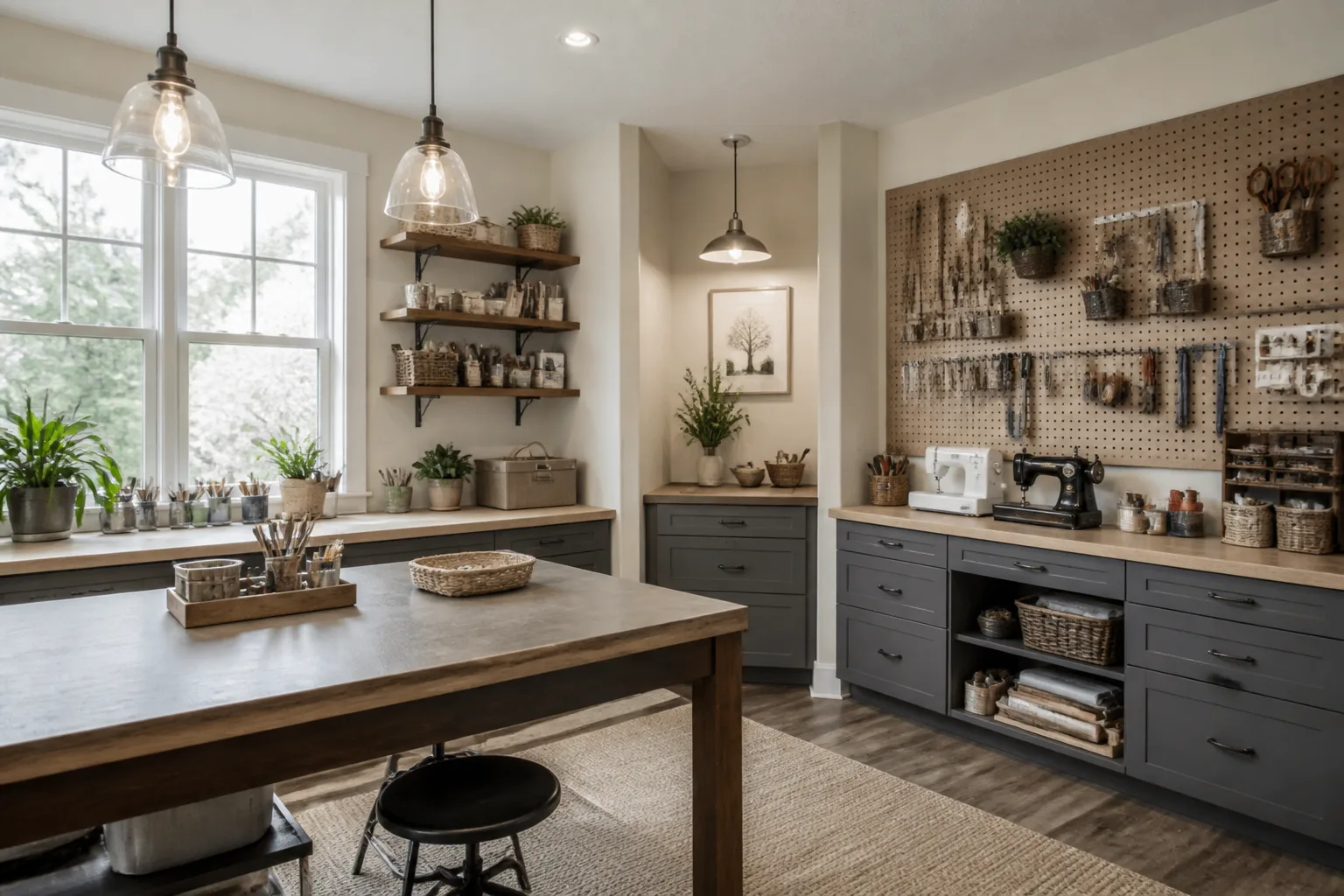
What a L-shaped craft room is really dealing with
An L-shaped room is two rectangles that cannot see each other, joined at a corner both of them want. Treat it as one room and the short leg becomes a dumping ground the sofa turns its back on. Treat it as two — each leg with its own job, centre and light — and the corner becomes a hinge rather than a leftover: the one spot in the room that belongs to both zones and holds whatever they share. None of that changes what the room is for: a craft room is hired for projects that stay out: the half-finished quilt, the drying print, the sorted beads. That makes it a workshop planning problem — a work surface at the right height for the craft (sewing sits, cutting stands), storage that sorts by project rather than by object, and cleanability designed in from the floor up. The luxury it offers over the kitchen table is persistence: close the door mid-project and nothing has to be put away.
The layout that gets both jobs done
Hold the craft room's own numbers first — a seated craft surface lands at 72–76cm; a standing cutting table at 90–95cm. Then let the constraint pick the arrangement: a distinct job per leg: living + dining, sleeping + dressing, desk + reading; the hinge corner given something both legs use — shared storage, a plant, a lamp; sightline discipline: from each leg’s seat, the view into the other leg is composed.
Furniture that earns its floor here
The pieces a craft room cannot do without are the main work table, biggest the room takes, a pegboard or tool wall over it, clear-front storage — labels lie, transparency doesn’t. Under the L-shaped condition, each of them is auditioned against the same test: a distinct job per leg: living + dining, sleeping + dressing, desk + reading.
What to rule out on day one
The L-shaped version of this room punishes one big arrangement trying to span the corner — something always ends up unreachable; the short leg as informal storage, visible from every seat in the long one. And the craft room's own classic error still applies: decorative storage — ribbon-tied boxes of chaos — that turns every project into an excavation.
Lighting it
Each leg gets its own scheme and switch; the hinge corner gets one shared source. Lighting the whole L from the long leg leaves the short one as a cave that nobody walks into after dark. The house’s brightest room: a strong neutral overhead layer (this is the one room where 4000K everywhere is right), plus a task lamp at the needle or blade. Colour-accurate light matters — thread matched under warm light is a different colour by daylight.
The move to make this weekend
Name each leg’s job out loud and move everything that does not serve that job out of that leg. The L stops being a difficult room and becomes two easy ones the moment the jobs stop leaking. In a craft room that lands next to the fixed rule of the room: a finishing zone where things dry or block undisturbed: 60cm of shelf or line, out of the walking path.
Dimensions to hold onto
However the finishes go, the geometry stays: Walk-around access to the main table on at least two sides: 60cm each. Frequently used tools within the seated reach arc — 60cm — and pegboard beats drawers for anything used weekly.
Questions
- Is a L-shaped craft room worth designing around?
- Yes — two rooms sharing a corner. Stop furnishing the letter and furnish them. The pages here treat the L-shaped condition as the starting brief, not a defect to apologise for.
- Which single change helps a L-shaped craft room most?
- Name each leg’s job out loud and move everything that does not serve that job out of that leg. The L stops being a difficult room and becomes two easy ones the moment the jobs stop leaking.
- How do I light a L-shaped craft room?
- Each leg gets its own scheme and switch; the hinge corner gets one shared source. Lighting the whole L from the long leg leaves the short one as a cave that nobody walks into after dark.
- What gets bought and regretted most in this room?
- Decorative storage — ribbon-tied boxes of chaos — that turns every project into an excavation. Under the L-shaped condition, add: one big arrangement trying to span the corner — something always ends up unreachable.
- Can I try these ideas on a photo of my own craft room?
- That is what the Studio is for: upload a photo of the actual room and redesign it with the L-shaped playbook applied. A new account starts with 4 free credits and a Standard render costs 4, so the first look is free.