shared home library
Two people’s stuff, tastes and hours in one room. The design is the treaty. Here is how that plays out in a home library: the layout that survives it, the furniture worth keeping, the lighting plan, and a way to preview it all on a photo of your own room.
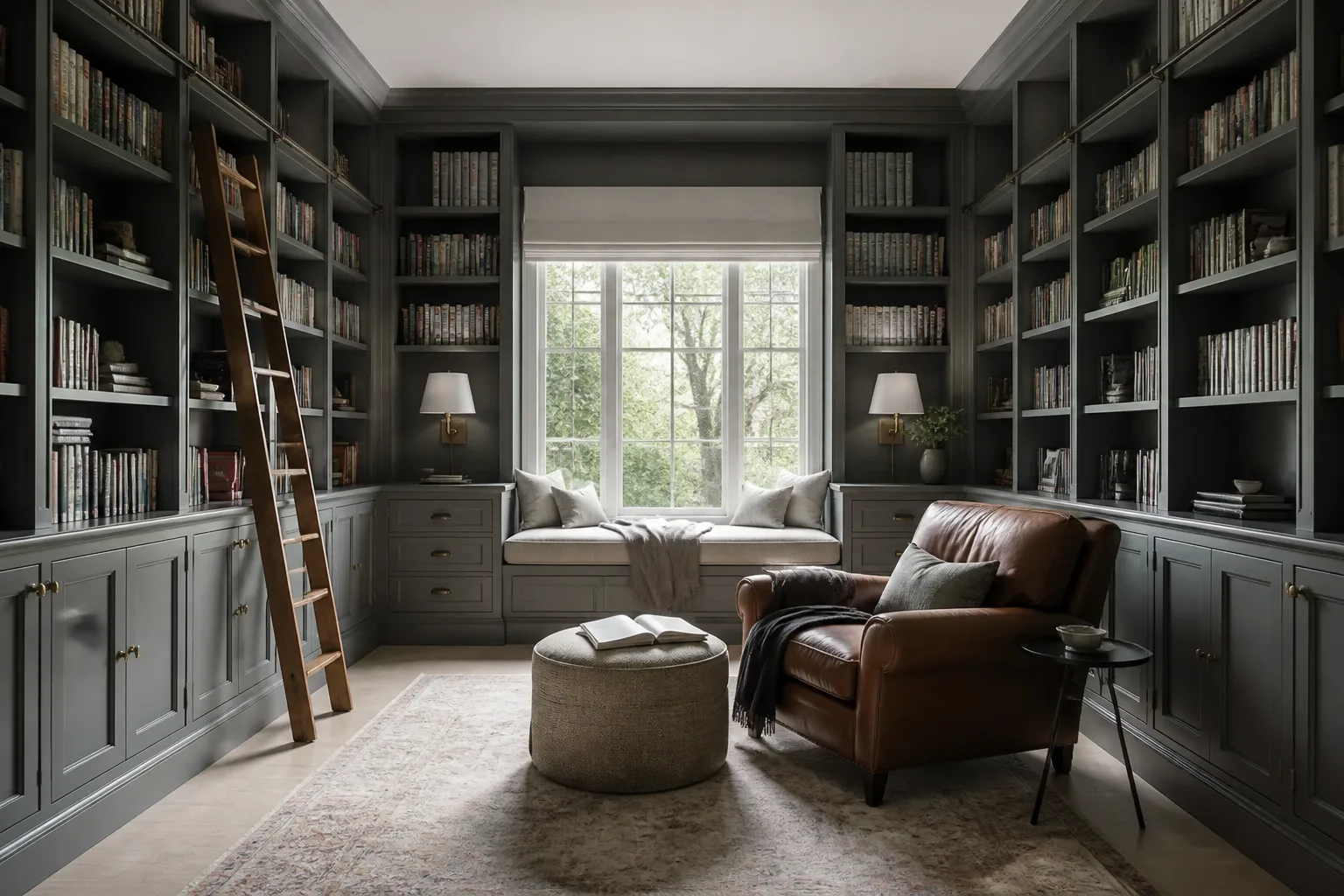
What a shared home library is really dealing with
A shared room — couple, siblings, flatmates — fails when it is designed as one person’s room that another person sleeps in. It needs symmetry where the sharing is equal (bedside tables, lamps, storage volume) and honest asymmetry where it is not (the early riser gets the wardrobe by the door; the desk belongs to whoever works). The visible surfaces need a jointly agreed palette precisely because the invisible ones — drawers, cupboards — are where each person’s chaos gets to live unjudged. None of that changes what the room is for: a library is hired by its shelving: the room is a storage system you sit inside. The design questions are structural before they are decorative — how many linear metres of books exist (measure them; everyone guesses low), whether the floor takes the load (a full wall of books is a grand piano’s weight), and where the reading happens once the walls are working. Get the metres, the weight and the chair right, and the atmosphere arrives by itself; no room styles itself as reliably as one lined with real, read books.
The layout that gets both jobs done
Hold the home library's own numbers first — count linear metres of books, add 30% for growth: that number sizes the room. Then let the constraint pick the arrangement: equal storage volume per person, enforced by furniture rather than promises; a bedside table and reachable light per sleeper, non-negotiable; one shared palette for visible surfaces, chosen together, however plain.
Furniture that earns its floor here
The pieces a home library cannot do without are shelving as architecture — to the ceiling, around the door if needed, one serious reading chair per regular reader, a library table or broad ottoman for the open-face pile. Under the shared condition, each of them is auditioned against the same test: equal storage volume per person, enforced by furniture rather than promises.
What to rule out on day one
The shared version of this room punishes one person’s taste applied wall to wall as a fait accompli; a single ceiling light governed by whoever is nearest the switch. And the home library's own classic error still applies: decorative shelving depth (20cm) that fits paperbacks and nothing else.
Lighting it
Independent control matters more than fixture beauty: two dim personal sources outperform one perfect pendant, because a shared room is two schedules pretending to be one. Shelf-washing light for the books (vertical surfaces lit make the room), reading lamps at the chairs, and a general layer kept low. The classic mistake is downlights in the aisle: they light the floor between you and the books, and the spines stay dark.
The move to make this weekend
Give each sleeper their own controllable light this week — a clip lamp counts. Most shared-room friction is really lighting friction, and it dissolves the day both people can read, wake and wind down on their own schedule. In a home library that lands next to the fixed rule of the room: the reading chair earns the window; its lamp goes over the shoulder at 100–110cm.
Dimensions to hold onto
However the finishes go, the geometry stays: Shelves: 28–32cm deep, 30–35cm vertical spacing for most books, one taller run for art books. Aisle in front of shelving: 75cm to browse, 100cm where two people pass.
Questions
- Is a shared home library worth designing around?
- Yes — two people’s stuff, tastes and hours in one room. The design is the treaty. The pages here treat the shared condition as the starting brief, not a defect to apologise for.
- Which single change helps a shared home library most?
- Give each sleeper their own controllable light this week — a clip lamp counts. Most shared-room friction is really lighting friction, and it dissolves the day both people can read, wake and wind down on their own schedule.
- How do I light a shared home library?
- Independent control matters more than fixture beauty: two dim personal sources outperform one perfect pendant, because a shared room is two schedules pretending to be one.
- What gets bought and regretted most in this room?
- Decorative shelving depth (20cm) that fits paperbacks and nothing else. Under the shared condition, add: one person’s taste applied wall to wall as a fait accompli.
- Can I try these ideas on a photo of my own home library?
- That is what the Studio is for: upload a photo of the actual room and redesign it with the shared playbook applied. A new account starts with 4 free credits and a Standard render costs 4, so the first look is free.